
6 Operational Shifts Play Café Owners Are Making in 2026
If you’ve been in this industry for any length of time, you already know that most of the conversations tend to focus on growth.
More revenue streams.
More offerings.
More experiences.
More complexity.
And while those conversations absolutely have their place, there is another layer of change happening right now that deserves just as much attention.
Because what I’m seeing across Play Maker Society and with my private clients is not just growth—it’s refinement.
Owners are starting to ask a different question:
“How do I make this business easier to run?”
Not smaller.
Not less profitable.
Just… more manageable.
And that shift is leading to a series of quieter, more operational changes—microtrends that aren’t flashy, but are having a significant impact on owner quality of life, team efficiency, and long-term sustainability.
The important thing to understand is that none of these trends are inherently “good.”
Every single one comes with trade-offs.
Some will simplify your systems while slightly limiting flexibility.
Others will improve predictability while requiring stronger boundaries.
And some, if implemented too early or without intention, can actually create more complexity instead of less.
So the goal here is not to copy what you see other owners doing.
The goal is to understand these shifts deeply enough to decide which ones actually make sense for your business, your market, and your capacity.
1. Moving Toward Cashless Operations
One of the most noticeable shifts is the move toward fully cashless systems.
This is not about being modern for the sake of it. It is about eliminating friction.
Cash introduces an entire layer of operational complexity—balancing drawers, handling discrepancies, training staff, managing change, and adding time to both opening and closing procedures.
Removing it simplifies everything.
Transactions move faster.
Lines move faster.
End-of-day processes become significantly cleaner.
For businesses running lean teams or high-volume weekends, this can be a meaningful improvement in both efficiency and stress levels.
However, this is not a universally positive change.
Play cafés serve a wider demographic than many other businesses. Grandparents, caregivers, and party guests often rely on cash, and removing it can eliminate certain purchases entirely.
There is also the reality of processing fees on every transaction.
So while the operational simplicity is undeniable, the trade-off is accessibility and, in some cases, lost impulse revenue.
The right decision depends entirely on your customer base and what type of friction you are trying to eliminate.
2. Collecting Party Payments in Advance
Another shift gaining traction is moving party payments to days—or even weeks—before the event.
This is one of those changes that seems small on paper but has a disproportionate impact on how your weekends feel.
When payment is collected on the day of the party, your team is pulled in two directions at once—hosting and transacting.
They are greeting guests while tracking down balances.
They are managing experiences while handling payments.
And often, those conversations happen in front of children and guests, which can feel awkward and unpolished.
When payment is handled in advance, that entire layer disappears.
Your team stays in hospitality mode.
Your revenue is predictable before the weekend even begins.
And cancellations are far less disruptive.
The trade-off is that this requires clear communication and firm policies.
Some customers will initially resist paying ahead of time, especially if they are used to more flexible systems.
But when positioned as standard procedure, most adapt quickly.
This is a classic example of trading short-term discomfort for long-term simplicity.
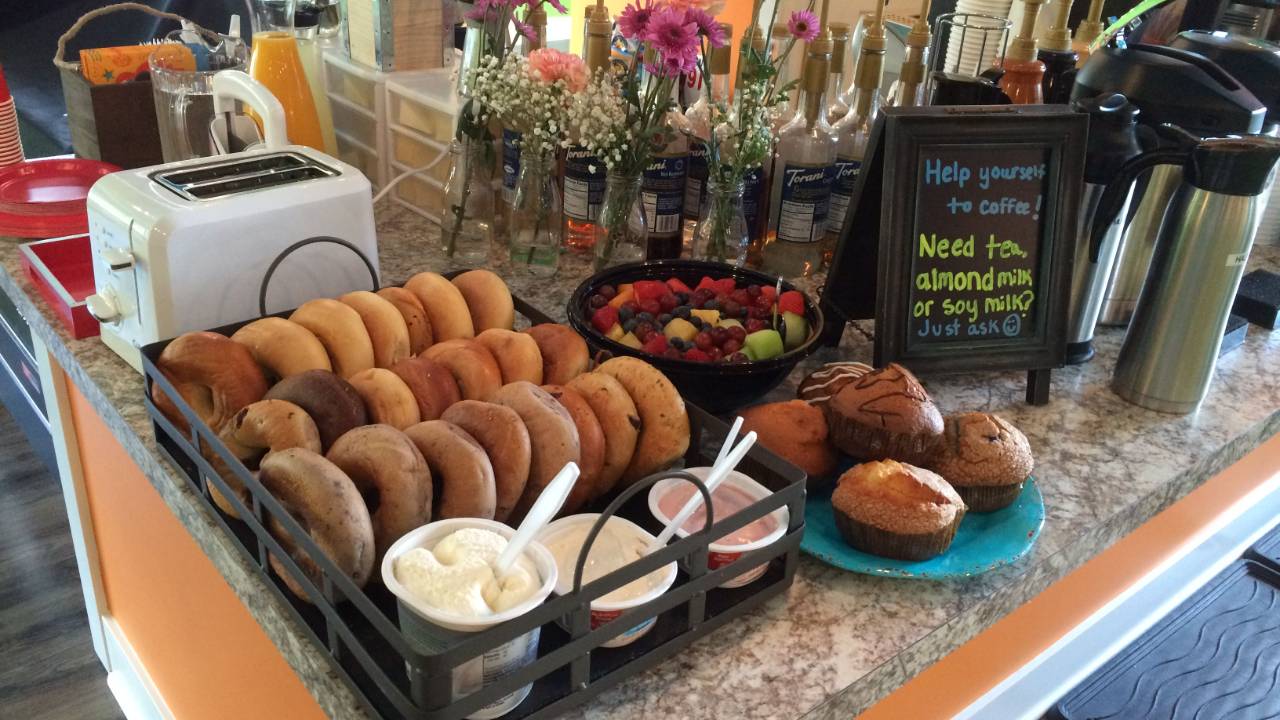
3. Simplifying (or Eliminating) Traditional Drip Coffee
Coffee is often viewed as a non-negotiable part of the play café model.
But what’s changing is how it is being executed.
More owners are stepping back and evaluating whether traditional drip coffee actually makes sense for their operations.
Drip coffee requires constant monitoring, creates waste, and typically delivers lower margins compared to other beverage options.
From a workflow perspective, it can also create unnecessary complexity for staff.
As a result, some owners are simplifying—focusing on cold brew, espresso-based drinks, or grab-and-go options that are faster, more consistent, and easier to manage.
Operationally, this makes a lot of sense.
But again, there is a trade-off.
In many spaces, drip coffee is not purchased by the primary customer—it is purchased by grandparents and older guests.
Removing it can subtly shift the experience in ways that are easy to overlook.
Some businesses choose to keep a minimal option. Others remove it entirely.
The key is making the decision based on actual customer behavior, not assumptions.
4. Shifting to Short-Term or Seasonal Memberships
Memberships continue to be one of the most valuable revenue streams in this industry.
But the structure of those memberships is evolving.
Instead of relying solely on open-ended recurring subscriptions, some owners are experimenting with shorter-term options—three-month passes, seasonal bundles, or fixed commitments.
This shift is largely driven by operational reality.
Recurring memberships come with administrative weight—failed payments, cancellations, customer service issues, and ongoing management.
At the same time, customer usage is rarely consistent year-round.
Seasonality plays a significant role, and shorter-term memberships often align more naturally with how families actually use these spaces.
They also feel psychologically easier to commit to.
The trade-off is that you lose some of the automation that makes recurring revenue so powerful.
You need to be more intentional about renewals, promotions, and retention.
But for many owners, the reduction in operational friction outweighs the loss of automation.
5. Moving Toward Reservations for Open Play
Reservations are another shift that is becoming increasingly common, particularly during peak times.
At first glance, this can feel restrictive.
But from an operational standpoint, it introduces a level of predictability that is difficult to achieve with walk-in-only models.
Without reservations, staffing and preparation become guesswork.
You are either overstaffed or understaffed.
Overprepared or underprepared.
And both scenarios come with a cost.
Reservations provide visibility.
You know what your day looks like.
You can staff appropriately.
You can protect capacity and maintain a consistent guest experience.
And that last piece matters more than most owners realize.
An overcrowded space does not feel popular.
It feels overwhelming.
Reservations help protect the quality of your environment.
The challenge is perception.
Some customers resist planning ahead, especially if they are used to drop-in flexibility.
But when framed as guaranteed entry rather than restriction, many families actually prefer it.
6. The Rise of the “Third Space” Model
Perhaps the most complex shift is the move toward positioning play cafés as “third spaces” or community hubs.
Not just a place for open play.
But a place where families spend time across multiple touchpoints—classes, events, co-working, café visits, retail, and more.
When executed well, this model can significantly increase customer lifetime value.
You become part of a family’s routine.
Not just an occasional destination.
However, this is also where many businesses begin to feel overwhelming.
Because each additional offering introduces a new layer of complexity—marketing, scheduling, staffing, and operations.
What starts as diversification can quickly become fragmentation.
Instead of running one cohesive business, you are managing multiple mini businesses simultaneously.
The key is not to avoid this model entirely.
It is to approach it with intention.
The most successful examples are built gradually.
A core revenue stream is established first.
Systems are developed.
Then additional offerings are layered in strategically.
The goal is not to do everything.
The goal is to build something that is both valuable to your community and sustainable for you to operate.
Simplification Is a Strategy
What all of these "micro-trends" have in common is not innovation.
It is simplification.
They are about removing friction.
Reducing unnecessary complexity.
And creating systems that are easier to manage consistently.
Because ultimately, the success of your business is not just measured in revenue.
It is measured in sustainability.
Can your team execute this consistently?
Can you maintain this pace long-term?
Does your business feel manageable to run?
Sometimes the most strategic move is not adding something new.
It is refining what already exists.
And in many cases, those quieter decisions are the ones that create the most meaningful change.
About The Author

Michele Caruana
Play Cafe Academy Founder & Blog Author
I have over a decade of hands-on local business experience and tough lessons under my belt, and I am passionate about helping current and prospective play based business owners AVOID the same mistakes myself and SO many other business owner's make. Even though I have a Master's Degree in Economics and Years of Business and Marketing experience, it took me YEARS to "crack the code" and turn my Indoor Playground from an expensive hobby into a business-- and I want to get YOUR business get there in less time and with much less stress.
Recent Posts
Categories
All Categories