
2026 Indoor Playground and Play Café Trends, Part 1 (Planning and Design Edition)
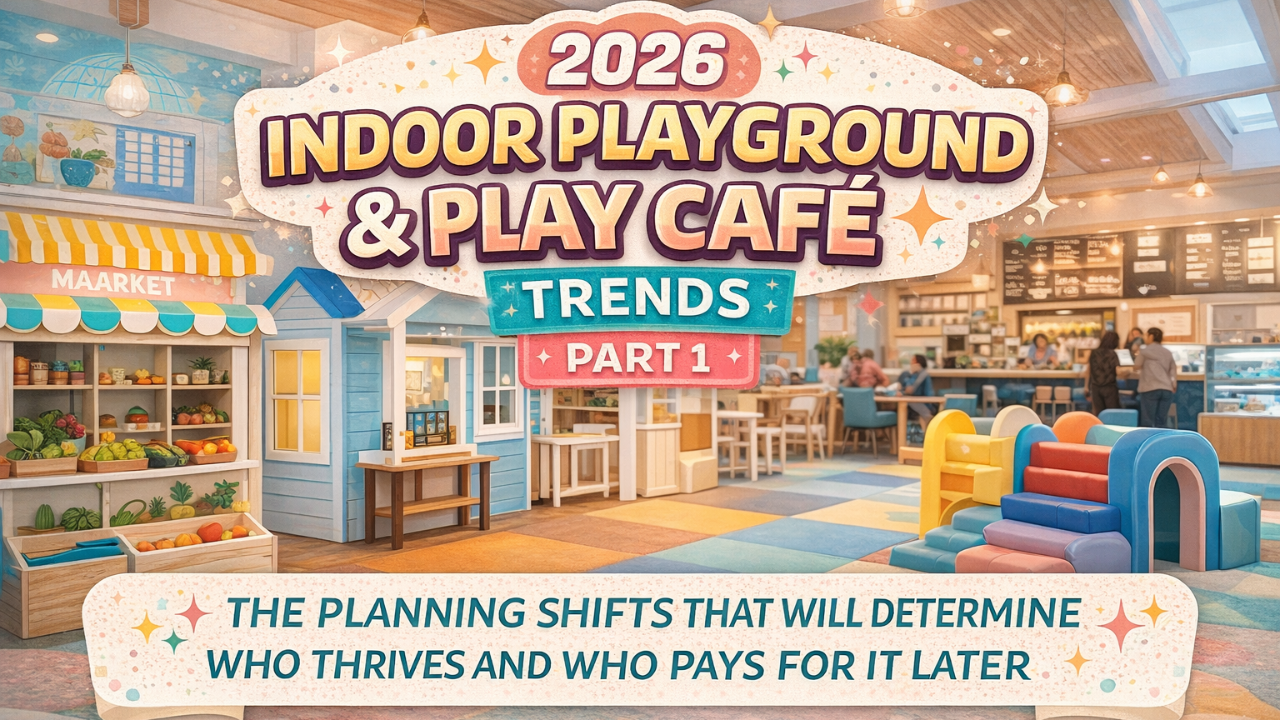
Every year since 2019, I’ve released a trends episode for the indoor playground and play café industry—and it consistently becomes some of the most watched and listened-to content I put out. That’s not an accident.
These episodes are built from real experience, real conversations, real numbers, and real decisions owners are making right now—inside my group coaching program, Play Maker Society, at my live events for play space owners, and in 1:1 sessions.
I opened my first indoor playground in 2015 (which is now more than a decade ago, and that still feels insane).
Since then, I’ve worked with thousands of owners at every stage of this business. I’ve seen the good, the bad, and the ugly—and at this point, I feel pretty confident saying I’ve almost seen it all.
I’ve coached people before they ever sign a lease and helped them avoid costly mistakes. I’ve supported owners through build-outs, relocations, and legal issues. I’ve also worked closely with established businesses expanding, franchising, licensing, adding revenue streams, or preparing to exit and sell.
And I don’t live in an indoor play bubble. I spend a lot of time zooming out and paying attention to what’s happening in the broader family entertainment world—through close relationships with top vendors and by following what’s being showcased and discussed at IAAPA and other industry events. Much of that innovation is designed for massive facilities and theme parks, but the expectations it creates around experience, pricing, and how families spend always trickle down into our corner of the industry.
This year, I noticed patterns I couldn’t ignore. I’ve been taking notes since January on the questions, problems, and “stuck points” owners keep hitting.
Before we get into the official trends, there are two foundational issues I need to call out—because they explain why so many businesses struggle even when they’re “doing all the right things.”
Two patterns that are quietly sabotaging new and struggling spaces
1) Marketing can’t fix a bad layout
One of the biggest patterns I keep seeing—especially with newer spaces that are struggling and booking 1:1 sessions with me—is the belief that good marketing can fix almost anything.
It can’t.
You can’t out-market a bad layout or a half-done buildout. A viral reel won’t fix poor flow, unexciting equipment, or a space that doesn’t feel intentional or designed around how families with young kids actually want to play, stay, and spend money in 2026.
When the design doesn’t work, the owner ends up trying to compensate with more ads (which, spoiler alert, often don’t work), more promos, more giveaways, and way more hustle—just to get the same results other spaces get naturally. Owners who design their space and equipment intentionally from the start don’t need louder marketing. They get better results from the same effort because the space itself does the selling.
2) Using AI as a replacement for experience is creating expensive mistakes
Another trend I’m seeing in my 1:1s (because Play Maker Society members could never) is owners leaning way too heavily on ChatGPT to plan and design their business—using it as an apples-to-apples replacement for experience, mentorship, or real-world testing instead of as a support tool.
AI is powerful. I use it constantly. But when it’s treated like the decision-maker—the all-knowing wizard—instead of the assistant, the cracks show. I can spot an AI-developed business plan a mile away because they all look the same and they all make the same mistakes.
I’ve worked with owners who built their entire pricing, layout, staffing plans, and even revenue models inside ChatGPT—and they pay for it later in rework, retraining, and lost momentum once they enter this highly nuanced, often counter-intuitive industry that AI simply doesn’t understand yet.
To be clear: I’m not telling you not to use AI. In fact, using AI well is becoming the baseline. Owners who aren’t using it will be left behind. But the smartest owners use AI to move faster—not to skip thinking, validation, or critical industry context.
Why this year’s trends are split into two parts
What I’ve learned—especially from sitting in rooms with hundreds of owners at my live events—is that the most expensive mistakes in this industry rarely look like mistakes at the start. They’re the decisions that feel “good enough” early on, then quietly lock you into layouts, pricing models, staffing structures, and leases that are brutally expensive to unwind once the doors are open.
The owners who pay attention to the shifts early get to make smart choices while it’s still easy and affordable. The ones who don’t plan intentionally usually end up paying for it later—redoing the space, fixing pricing or staffing problems, or feeling stuck in a business that’s harder to run than it ever needed to be.
That’s why these trend episodes matter.
And this year, I’m splitting the trends into two parts because they naturally fell into two buckets:
-
Part 1: business and space planning (foundation decisions)
-
Part 2: operations and execution (how owners are running and optimizing)
Part 1 is intentionally planning-focused—but it’s not just for dreamers. It’s for anyone who is:
-
opening their first play café or indoor playground
-
reworking a space after outgrowing the original layout
-
moving locations
-
planning an expansion or second location
And if you’re already open and thinking this doesn’t apply to you, keep reading. Many owners eventually relocate or expand. Play Maker Society members Alicia (Gentle Hands) and Betsy (Backyard Play Café) have both successfully relocated in recent years, and many more are planning to. When they rebuilt, they didn’t just recreate what they had—they used what they learned about flow, sizing, customer experience, pricing, and what families actually respond to in order to design something stronger from the ground up.
The owners who struggle long-term usually aren’t bad operators. They’re smart, capable people who made early decisions that weren’t aligned with their goals or income expectations—and then tried to make it work by pushing harder instead of fixing the foundation.
With that in mind, here are the seven planning and design trends that will shape indoor play in 2026.
Trend 1: Flexible pricing is replacing one-size-fits-all models
A major shift heading into 2026 is how pricing itself is evolving—and this was a big conversation at IAAPA.
For a long time, indoor playground pricing was rigid:
-
single visit
-
monthly membership
-
maybe an annual option if you were ambitious and listened to my content
And for a while, that worked.
But families’ lives aren’t predictable anymore. Schedules are chaotic. Commitments change. Parents are more cautious about recurring charges—not because they don’t value play, but because they’re juggling subscriptions everywhere.
What I’m seeing now is a move toward flexible, intentional pricing structures that reduce friction without racing to the bottom.
At IAAPA, dynamic pricing came up again and again—not as “raise prices constantly,” but as responsive pricing: based on demand, time of day, capacity, or use case. In our industry, the principle shows up through things like:
-
off-peak memberships (including seasonal options)
-
limited-time access passes
-
short-term commitments that feel safer
-
non-renewing memberships (3-month or seasonal)
This works incredibly well inside Play Maker Society.
Alicia from Gentle Hands introduced short-term membership options specifically for families navigating transitions—new babies, therapies, school changes. It removed the mental barrier of “what if we don’t use it enough,” and her conversion rate went up—not down.
Kristina from Busy Bee Play Café layered 3-month memberships into her model as well. Families committed for a defined season, felt confident about the value, and then reassessed—which actually increased trust and long-term retention.
Tiffany from MYPlay Café has also shared the success she’s seen with shorter-term, non-renewing membership options.
Here’s what most owners miss: flexibility does not reduce loyalty. It often creates it. When families feel respected instead of trapped, they stay longer.
And flexible models help you smooth revenue without discounting. You’re not saying “pay less.” You’re saying “pay in a way that fits your life.” That’s a powerful shift.
Flexible pricing opens the door to homeschool families, families with kids with disabilities who have heavy therapy commitments, families with seasonal occupations, and more. The spaces leaning into this aren’t being fickle—they’re being strategic.
In 2026, the strongest pricing models won’t be the cheapest or the most complicated. They’ll be the ones that feel human, intentional, and aligned with how families actually live.
Trend 2: Experience-led play design is the new baseline
What used to work in this industry doesn’t automatically work anymore—not because anyone did anything wrong, but because the context has changed.
Not long ago, it was acceptable to do a minimal buildout, fill a space with generic pieces ordered online, and charge for open play. Parents were just relieved to have somewhere indoors. Expectations were lower. Options were limited.
That era is over.
Families today have more exposure, more choices, and a higher baseline for what “good” looks like—through social media, especially TikTok, and through real-life experiences in thoughtfully designed spaces.
So when parents walk into a play space, they’re not inventorying equipment. They’re reacting to how it feels.
There’s a split-second emotional scan:
Is this clean? Safe? Can I relax here?
Does this feel calm or chaotic?
Does this feel intentional or thrown together?
Do I want to stay—or rush through?
Kids are doing the same scan without words: Is this exciting? Can I move freely? Do I want to stay?
Parents aren’t just paying for play anymore. They’re paying for relief. They want a space where someone has already thought through the chaos. A place that feels controlled, safe, and manageable.
And that shift drives everything downstream: dwell time, café sales, retail, parties, memberships, and re-booking.
This is also why adding more equipment doesn’t move the needle like it used to. More stuff doesn’t equal more value if the space feels overwhelming, disjointed, or generic. Sometimes it makes it worse.
The spaces performing best are thinking about how the space is used, not just what fills it:
-
intentional layouts that prioritize sightlines and flow
-
adult-friendly seating inside the play area (not banished to the perimeter)
-
play mixes that balance gross motor with imaginative play
-
small operational upgrades that reduce friction, like in-play-area ordering (QR or iPads) so parents don’t have to leave, wait, or herd kids just to get coffee
This shows up in details owners don’t always label “strategy”: lighting that doesn’t feel clinical, sound control that reduces adult stress, and design choices that make the experience feel elevated and trustworthy.
A real-world example of experience-led design done well is Georganne from Mama’s Play. From the beginning, she decided to build a premium, intentional experience. Her equipment was cohesive and custom, not generic. The décor, furniture, and layout supported how families actually move and spend time. Seating was planned, not leftover. Café and retail were integrated, not squeezed in.
Because the experience supports the pricing, her luxury, all-in party package is her top-performing option. Families consistently choose it because the space already communicates premium value. There’s no disconnect between what they see and what they’re being asked to invest in.
This is the power of experience-led design: when the space is built intentionally, premium offerings don’t need heavy selling. Revenue grows because the experience was designed to support it.
And I want to be blunt about something: affluent areas aren’t immune anymore. During the pandemic, commercial-style play equipment became more accessible to consumers, and many wealthy families literally have indoor playgrounds in their basements. The bar is higher. This is what a more mature, competitive industry looks like.
Owners who ignore experience end up fighting friction everywhere: shorter visits, more complaints, weaker membership conversions. Owners who design for emotion create spaces people want to linger in—and spend money in—without needing to be sold.
Trend 3: Cafés that drive the business
One of the biggest shifts heading into 2026 is how the most successful owners treat their café: not as a nice add-on, not as something they’ll figure out later—but as one of the few places where the math actually works.
Margins in indoor play are tight. Rent is expensive. Payroll is expensive. Insurance, utilities, repairs—none of it is optional. That means you don’t have room to give profit away. And yet many owners still rely heavily on third-party vendors for coffee, pastries, pizza, and party food because it sounds supportive or easier.
The problem is: sounding nice doesn’t pay the bills.
The businesses doing the best aren’t necessarily the ones bringing in the most revenue. They’re the ones keeping the most of what they generate. And cafés—when done intentionally—are one of the most reliable ways to do that.
A café isn’t just extra. It changes how families use your space, how long they stay, and how much they spend—without needing more foot traffic or more hustle.
Coffee, tea, espresso drinks, simple snacks—these items can be high-margin once you understand cost of goods and pricing. In my own business, café sales created meaningful net profit that wasn’t tied to open play volume or party bookings, and that margin immediately relieved pressure on rent, payroll, and paying myself as the owner.
Cafés also change behavior. When adults can get what they already want, parents don’t rush out, they’re more relaxed, and visits become more valuable—without raising prices or overcrowding the space.
Where cafés go wrong is when they’re treated like an afterthought.
The cafés that perform are integrated into the flow of the space, staffed and trained so ordering doesn’t feel disruptive, priced and presented naturally, and woven into everything else: party upgrades, event add-ons, membership perks. That’s where the compounding effect happens.
There are exceptions—but they’re rare and intentional.
Lindsay from Spirited Play Labs is a great example. Her business has a clear niche and a revenue model that doesn’t rely on traditional open play patterns. She’s membership-based, serves children with disabilities in a highly specialized and in-demand way, and has built programming families rely on. That focus has helped her scale to three locations in the San Francisco area. Because of her mission and positioning, she’s also able to tap into significant recurring government funding—so the café doesn’t need to carry the same weight because something else has been deliberately designed to do that job.
That’s the distinction: the businesses that truly don’t need cafés have another stream doing the heavy lifting by design. What doesn’t work anymore is skipping the café and hoping open play, parties, or classes will make up for it. They won’t. Cafés enhance those streams—they don’t compete with them.
Trend 4: Immersive spaces are becoming the expectation
This is where the influence of larger experiential spaces starts to show up—and it was a major topic at IAAPA.
Immersion doesn’t mean turning your indoor playground into a theme park. It means creating moments that feel like a world, not just a room filled with toys.
Experience-led design is about function. Immersive design is about story.
And it doesn’t have to be massive or expensive. What matters is cohesion.
I’m seeing immersion created through:
-
one anchor feature that becomes the visual heart of the room (a custom playhouse, tree, or structure)
-
cohesive pretend environments (a market, street, or mini town) rather than scattered role-play pieces
-
re-theming one key feature each year so returning families always notice something new
-
fully story-driven worlds like nature, jungle, or adventure that feel unified
Tiny Play does this beautifully by re-theming a playhouse to spotlight local businesses—turning one structure into both a story moment and a community connection. Little Play Avenue builds immersion by designing the entire space around a neighborhood concept so everything belongs together. Spaces like Wild Child Museum or Menagerie go deeper with coordinated structures, murals, and textures that make kids feel like they’re stepping into something, not just playing on something.
Immersion also overlaps with shareability. When you give parents something specific to capture—a recognizable scene or focal point—customers do the marketing for you without being asked.
And organic word-of-mouth still outperforms every paid platform in this industry.
The owners leaning into immersion aren’t chasing trends. They’re designing environments families remember, talk about, and choose again.
Trend 5: Designing spaces to age with the child
For the past five years, the standard age range has been 0–5. That made sense for a long time.
But I’m seeing a clear shift: more new spaces—and more successful existing ones—are intentionally designing for kids up to 8, 9, even 10.
Families don’t want to “graduate” out of a space every year. Parents are tired of constantly finding a new routine, a new membership, a new camp once their child outgrows toddler play.
When your space caps out at five, you build in churn—right when trust, loyalty, and spending potential are highest.
Designing a space that ages with the child solves that. It shows up in:
-
gross motor elements usable at different skill levels
-
open-ended play that evolves instead of becoming boring
-
zones that support independence and challenge
-
layouts flexible enough for open play, camps, and group programming
This trend matters even more when you look at camps. Spaces that only serve 0–5 often struggle with camps: age caps are lower, programming is more staff-heavy, pricing has a ceiling, and parents are hesitant to commit.
When your space supports kids up to 10, camps become easier to sell and scale: school-age summer camps, day camps during breaks, themed camps, mixed-age programs that work. And because kids already know the space, enrollment feels familiar instead of risky.
This is one of the biggest ways owners are reducing seasonality right now.
In 2026, stable spaces won’t be the ones constantly chasing the youngest kids. They’ll be the ones keeping families longer.
Trend 6: Custom builds to stay competitive
Saturation is starting to matter.
Five years ago, opening an indoor playground was enough to stand out. In many markets, it no longer is.
When multiple spaces exist within driving distance, sameness becomes the enemy. Owners relying on cookie-cutter vendor packages become vulnerable. If a competitor opens with the same structures, same neutral palette, and same layout, the only differentiator left is price—and price wars are not where this industry wins.
Custom builds are becoming a form of market defense. That doesn’t always mean a massive investment. It can be one signature structure, a custom mural, a layout decision that makes your space instantly recognizable, or a feature no one else has.
This trend also shows up in branding—especially names.
Naming a new space has become genuinely difficult because markets are crowded and names blur together. If customers can’t distinguish you online, your brand is working against you.
In 2026, you need a name that is distinct, searchable, and brandable. That means thinking beyond “cute” and considering:
-
how it shows up in Google search and Instagram
-
whether it can grow with the business
-
whether it locks you into a narrow concept
-
and whether it’s legally safe
You also need to do proper trademark research—not just a quick Google search. I’ve seen owners invest heavily in signage, websites, murals, menus, and merchandise only to realize later their name is already trademarked or too close to another protected brand. Rebranding after momentum is expensive and avoidable.
In a crowded market, clarity beats cleverness. Memorability beats familiarity. And intentionality is no longer optional.
Trend 7: Inclusion and universal design are the standard, not a bonus
This isn’t a new idea. I was already talking about it on the Profitable Play Podcast back in 2025—but what has changed is the expectation.
Inclusion and universal design are no longer “nice extras” you highlight once in your marketing. By 2026, they’re becoming the baseline. Families expect spaces to work for more kinds of kids, caregivers, and needs—without having to ask for accommodations or explain themselves.
Universal design isn’t about creating a separate experience for certain families. It’s about designing spaces that work better for everyone:
-
clear sightlines
-
predictable flow
-
thoughtful lighting and sound
-
seating that actually works for adults
-
bathrooms that are easier to use
-
entry points that don’t create stress before families even walk in
When those things are missing, families don’t always complain. They just don’t come back.
What I said in 2025 still holds true: families with neurodivergent kids, kids with disabilities, sensory sensitivities, or medical needs can be some of the most loyal customers you’ll ever have—when a space works for them. But now those same principles benefit every family: strollers, siblings, grandparents, pregnant parents, exhausted caregivers.
This isn’t about adding more equipment. It’s about removing friction.
The best-designed spaces I’m seeing feel calmer, easier to navigate, less chaotic without being boring. They’re intentional about where noise lives, where quiet lives, and how families move through the space without feeling overwhelmed.
And inclusion is also a business decision. Spaces that are easier to use stay fuller for longer. Families stay longer. They spend more. They book parties more confidently. They recommend you without disclaimers like, “It’s fun, but…”
By 2026, inclusive design isn’t a differentiator. It’s a filter.
The question behind every trend
As we wrap up Part 1, don’t think of this as a list of ideas. Think of it as design decisions.
Every trend we discussed—pricing, experience, cafés, immersion, designing to age with the child, custom builds, universal design—comes down to one question:
What kind of business are you intentionally building?
Because once your space is designed a certain way, it quietly dictates everything else:
-
how long families stay
-
how much they spend
-
what they’re willing to commit to
-
how easy it is to sell memberships, camps, parties, and premium offerings
-
how much pressure the business puts on you day to day
This is why I separated planning from operations.
You cannot systemize your way out of a poorly designed experience. You cannot staff your way out of a space that doesn’t support how families actually behave. And you cannot market your way out of a business model that isn’t aligned with real life.
Before you move on to Part 2, pick one trend from this list and ask yourself:
“If I were building this business today—or rebuilding it intentionally—what would I do differently?”
Not ten things. Not everything at once. Just one decision you would make more intentionally if you were starting now.
Because when the foundation is right, operations get lighter. Staffing gets easier. Tech actually works. And the business stops relying on you to hold it together.
In Part 2, we’ll shift into the operational trends—how owners in 2026 are running these businesses in a way that reduces friction, protects their peace, and builds something that doesn’t collapse when they step back.
But none of that works unless the foundation makes sense.
I’ll see you in Part 2, posting soon!

About The Author

Michele Caruana
Play Cafe Academy Founder & Blog Author
I have over a decade of hands-on local business experience and tough lessons under my belt, and I am passionate about helping current and prospective play based business owners AVOID the same mistakes myself and SO many other business owner's make. Even though I have a Master's Degree in Economics and Years of Business and Marketing experience, it took me YEARS to "crack the code" and turn my Indoor Playground from an expensive hobby into a business-- and I want to get YOUR business get there in less time and with much less stress.
Recent Posts
Categories
All Categories